1 Mathematical Preliminaries
Throughout the course, we are going to define sets recursively, define relations on those sets (also recursively), and then prove relationships between these sets and elements of the sets that satisfy specific relations. We will also use a particularly expressive notion called a context as tool to streamline our definitions of relations. This tool is very powerful and expressive, so we’ll explore it in a more familiar setting here in this chapter before putting it to use in our study of type systems.
1.1 Defining Sets
We will define sets via rules that describe the membership of the set recursively. Generally, the definitions will consists of a number of base case elements of the set and ways to build bigger sets out of sets that are already built.
Here is a first example definition of a set, specifically the set of binary trees:
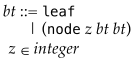
In words, this definition says that  is the
smallest set satisfying two conditions, one for each line of
the definition. The first line says that
is the
smallest set satisfying two conditions, one for each line of
the definition. The first line says that  is a
member of the set
is a
member of the set  . The second line says that, for
any integer
. The second line says that, for
any integer  and any two other binary trees,
 and
and  ,
, 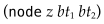 is a
member of the set
is a
member of the set  .
.
For example, we know that
 is a member of the set
 by using the first rule three times and the second
rule two times. Conversely, we know that
by using the first rule three times and the second
rule two times. Conversely, we know that 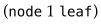 and
and  are not members of
the set, as the rules provide no way to build up elements
looking like those.
are not members of
the set, as the rules provide no way to build up elements
looking like those.
As a notational device, we will pun on the use of  both as the set and as an element of the set, using the name
of the element to indicate which set it comes from.
both as the set and as an element of the set, using the name
of the element to indicate which set it comes from.

1.2 Proving Properties by Induction
To do proofs with these relations, we use structural induction, a proof technique that generalizes the usual form of induction on natural numbers. When we do a proof by induction on natural numbers, we’re proving a property that’s indexed by natural numbers. We start by proving that the property is true when the natural number is zero, and then we assume that the property is true for some given natural number and prove that it holds for the next one. These two lemmas enable us to build up a proof for any particular natural number that we encounter later on, as any particular natural number can be found by starting at zero and counting up, one number at a time.
The root of this idea is the idea of a well-founded order, specifically, an ordering on a set that covers all of the elements in the set but where all of the descending chains in the order are finite. For the natural numbers, the ordering is simply the usual less-than ordering. That is, given any particular natural number, there are only a finite number of other naturals that are less than it, so chaining together these lemmas will always eventually bottom out, making the proof technique sound.
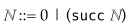
Taking this idea to our binary tree set definition, there
are two ways to create binary trees, either they are leaves
or they are nodes (which contain two smaller trees). So, if
we want to prove some property of binary trees we can
organize the proof into two parts: first we prove the
property for leaves and then we assume the property holds
for two arbitrary trees and show that it holds for the tree
you get by combining the two together with an arbitrary
integer using  . These then become the two lemmas
that can be chained together to obtain the proof for any
particular binary tree. In other words, if we can prove
those two facts, we know the property holds for all of the
binary trees.
. These then become the two lemmas
that can be chained together to obtain the proof for any
particular binary tree. In other words, if we can prove
those two facts, we know the property holds for all of the
binary trees.

Theorem. For any  with l leaves and height h,
l ≤ 2^h.
with l leaves and height h,
l ≤ 2^h.
Case one: the tree is a leaf. In this case, we know l is 1 and h is 0, so specializing the claim, we get 1 ≤ 2^0, which is true.
Case two: the tree is built with
 . Each
node contains two binary trees; let’s name them
. Each
node contains two binary trees; let’s name them  and
and  . Let’s also name their heights h_1 and
h_2, respectively and name the number of leaves they
have l_1 and l_2. Our goal is to show that the
number of leaves in the tree
. Let’s also name their heights h_1 and
h_2, respectively and name the number of leaves they
have l_1 and l_2. Our goal is to show that the
number of leaves in the tree 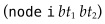 ,
which is l_1+l_2 (since all of the leaves of both
,
which is l_1+l_2 (since all of the leaves of both
 and
and  are in the tree) is at most
2^{max(h_1,h_2)+1}, as the tree
are in the tree) is at most
2^{max(h_1,h_2)+1}, as the tree
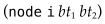 has the height max(h_1,h_2)+1
(from the definition of the height of a tree).
has the height max(h_1,h_2)+1
(from the definition of the height of a tree).As we doing this proof by induction, we also get to assume that the lemma we are proving holds for the trees
 and
and  . So, we know that l_1 ≤
2^{h_1} and l_2 ≤ 2^{h_2}.
. So, we know that l_1 ≤
2^{h_1} and l_2 ≤ 2^{h_2}.To complete the proof, we need to use some facts about numbers. By adding the two inductive assumptions, we know that l_1+l_2 ≤ 2^{h_1} + 2^{h_2} Since the maximum of two numbers is larger than either of them and exponentiation is increasing, we know 2^{h_1} ≤ 2^{max(h_1,h_2)} and similarly for l_2, so we have l_1 + l_2 ≤ 2^{max(h_1,h_2)} + 2^{max(h_1,h_2)} We can rearrange the right-hand side using properties of exponentiation and arrive at l_1+l_2 ≤ 2^{max(h_1,h_2) + 1} which was the goal.
QED.
1.3 Defining Relations to Identify Desired Subsets
In order to capture particular, preferred subsets of terms,
we will use relations on the sets of terms. The idea is that
these subsets will have some nice property that we are
interested in studying. As a first example, we can define a
relation that captures which trees are perfect binary trees.
A perfect binary tree is one where every path from the root
to a leaf has the same length. We write
 to indicate that
  is a
perfect binary tree and all the paths to leaves have length
is a
perfect binary tree and all the paths to leaves have length
 .
.
We define the relation inductively, just as the sets are defined inductively, using rules. We write the rules as sequents, meaning we write premises (assumptions) above a bar and a conclusion below the bar, and a name for the rule beside the bar. We take this to mean that whenever the premises hole, then the conclusion is true. Just like the definitions of the sets, the relations are the smallest ones that satisfy the rules, meaning that the only way to show membership in the relation is to use the rules.
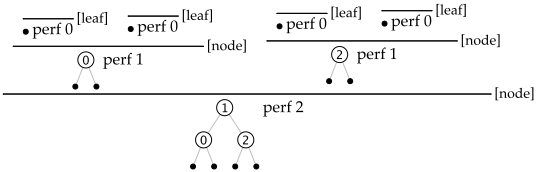
Let’s clarify this with an example. Here are the rules for perfect trees:
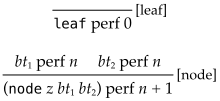
The first rule says that it is always the case (i.e.,
requiring no assumptions), that leaf nodes are perfect trees
with a path-length of zero. The second rule says that, if
 is a perfect tree of length
  and so is
 , then the tree
 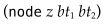 is a
perfect tree of length
is a
perfect tree of length  .
.

Perfect trees have only certain fixed sizes; there is, for
example, no perfect tree that has four nodes in it. We can
generalize the idea of a perfect trees a little bit to allow
such trees by saying that every path from the root to a leaf
has either a length  or
or  and,
furthermore, all of the paths of length
and,
furthermore, all of the paths of length  are to the
left and the paths of length
are to the
left and the paths of length  are to the
right, when drawn out. Such trees are called complete trees.
are to the
right, when drawn out. Such trees are called complete trees.
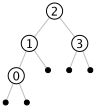
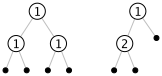
For example, the tree on the left is a complete tree of height four and the tree on the right is a tree of height four that is not complete because the bottom row of nodes is not filled in from the left.

We’ll write  to indicate that
 is a complete tree that has paths that are either
of length
is a complete tree that has paths that are either
of length  or of length
  . We can
define the relation in a manner similar to the definition
for perfect trees, using rules with assumptions and
conclusions:
. We can
define the relation in a manner similar to the definition
for perfect trees, using rules with assumptions and
conclusions:
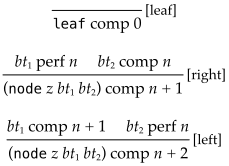
Note that these rules introduce a subtle point: with
complete trees, there are two different rules that can both
construct trees that end with a  .
.
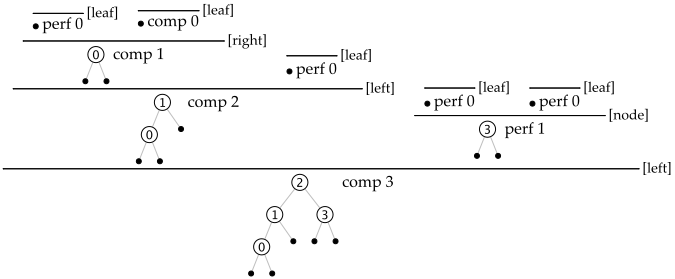
Here’s an example derivation, showing how the rules capture
the complete tree with four nodes shown above; it uses both
variants of the  rule.
rule.
1.4 Proving Properties by Induction using Relations
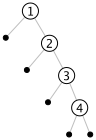
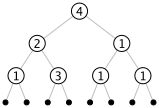
Earlier, we showed an exponential upper bound on the number of leaves in a tree. For an arbitrary tree, it is possible to include just a few nodes such that there is just one more leaf than the height of the tree. For example, here’s a tree with with a height of 4 and 5 leaves:
For perfect and complete binary trees, however, there must be many more leaves than the height. Let’s start with perfect trees, where there must be exactly 2^h leaves.
To prove this, we need to do induction again, and on the
structure of the tree, but because we know that the tree is
complete, we will have more information at each stage. There
is a catch, however: we will also have more requirements to
be able to use induction. The additional information and the
additional requirement both comes from the definition of the
 relation.
To be able to use the relation, we first prove a result that connects the shape of the binary tree (i.e., which rule was used to construct the tree) to the definition of the relation. This lemma is called inversion, and each relation comes with its own inversion lemma.
 then,
then,
If
 is
is  then
then  must be 0.
If
 is
is 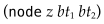 then
then  must be
at least
must be
at least  and
and  and
and

We can also connect the size of the natural number in the perfect binary tree relation to the possible tree shapes in a similar manner.
 then,
then,
If
 is 0 then
  must be
  .
.If
 is at least 1, then
 must be
  for some
  ,
,  ,
and
,
and  . Furthermore,
we know that
. Furthermore,
we know that  and
and

Equipped with the inversion lemma, we can prove the result about perfect binary trees. There is one subtle point here, however, that comes up in the second case. Specifically, bear in mind that the property we are trying to prove is itself an implication.
Theorem. For any binary tree  with l leaves and
height h, if
with l leaves and
height h, if  , then 2^h = l.
This “if  ...” plays a role as an
assumption (we get to assume that about the given tree) but
it also plays the role of an obligation, when we try to use
the inductive hypothesis.
...” plays a role as an
assumption (we get to assume that about the given tree) but
it also plays the role of an obligation, when we try to use
the inductive hypothesis.
Proof. By induction on the structure of the tree.
Case one: the tree is a leaf. In this case, we know l is 1 and h is 0, so specializing the claim, we get 2^0 = 1, which is true.
Case two: the tree is a node, so there are two other trees
 and
and  as well as an integer
 such that
  is
is
 . Let’s say that the height of
 is h_1 and it has l_1 leaves; also the
height of
is h_1 and it has l_1 leaves; also the
height of  is h_2 and it has l_2 leaves.
Now, as in the previous proof, we can do induction using
 and
and  . But, just as the theorem we are
proving requires us to know that
. But, just as the theorem we are
proving requires us to know that  and
and  are perfect, so too the inductive hypothesis requires us to
show that the trees are perfect before we can use it. Here
is where the assumption of
are perfect, so too the inductive hypothesis requires us to
show that the trees are perfect before we can use it. Here
is where the assumption of  and the
inversion lemma come in. Since we know that
and the
inversion lemma come in. Since we know that
 is true, by inversion
we know that
is true, by inversion
we know that  and
and
 . This lets us apply
induction, telling us that 2^{h_1} = l_1 and 2^{h_2}
= l_2. Take care when using induction in settings like this!
the inductive hypothesis matches the entire proof and that
proof has an implication in it; we must discharge that assumption
in order to use the inductive hypothesis. In this case, it is
straightforward, as get can satisfy the assumption directly
from inversion, but that won’t always be the case.
. This lets us apply
induction, telling us that 2^{h_1} = l_1 and 2^{h_2}
= l_2. Take care when using induction in settings like this!
the inductive hypothesis matches the entire proof and that
proof has an implication in it; we must discharge that assumption
in order to use the inductive hypothesis. In this case, it is
straightforward, as get can satisfy the assumption directly
from inversion, but that won’t always be the case.From here, we have to do algebraic manipulations to obtain the goal. Let’s start by adding the left- and right-hand sides of the facts we obtained from induction to get 2^{h_1} + 2^{h_2} = l_1 + l_2 Since our original tree
 has all of the leaves of
 and
and  and no more, we can simplify
the right-hand side to just l:
2^{h_1} + 2^{h_2} = l
Because the path length to any
leaf is always the same, we know that h_1 = h_2 and thus
we know that
2^{h_1} + 2^{h_1} = l
Using properties of the exponential function we
can simplify the left-hand side:
2^{h_1+1} = l
Furthermore, using the fact that h_1 and h_2
are the same and a property of max, we can adjust
the left-hand side to
2^{max(h_1,h_2)+1} = l
Now, the left-hand side looks like the definition of the
height function, so we can replace it with h:
2^h = l
which completes the proof.
and no more, we can simplify
the right-hand side to just l:
2^{h_1} + 2^{h_2} = l
Because the path length to any
leaf is always the same, we know that h_1 = h_2 and thus
we know that
2^{h_1} + 2^{h_1} = l
Using properties of the exponential function we
can simplify the left-hand side:
2^{h_1+1} = l
Furthermore, using the fact that h_1 and h_2
are the same and a property of max, we can adjust
the left-hand side to
2^{max(h_1,h_2)+1} = l
Now, the left-hand side looks like the definition of the
height function, so we can replace it with h:
2^h = l
which completes the proof.
QED.
Exercise 1. Our proof above used the fact that if two trees
 and
and  are both perfect with the same
 , i.e.,
  and
and
 , then the heights of the two trees
are the same. It is possible to prove this fact using
induction, but a simpler fact to prove is that if
, then the heights of the two trees
are the same. It is possible to prove this fact using
induction, but a simpler fact to prove is that if
 , then the height of
  is
is
 , and it implies the desired lemma. Prove it.
Complete trees do not have a simple characterization for the exact number of leaves, but there still have to be many leaves compared to the example from the start of this section. In particular, we can bound the number of leaves in a complete tree from below; in a complete binary tree of height h, there must be at least 2^{h-1} leaves.
Because the definition of complete trees is more complex, the proof requires a little more sophistication. To start we need an inversion lemma.
 then,
then,
If
 is
is  then
then  must be 0.
- If
 is
is 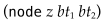 then either
 is at least 1,
 , and
, and
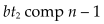 , or
, or is at least 2,
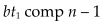 , and
, and

Theorem. For any complete tree  with l leaves and
height h, if
with l leaves and
height h, if  , then 2^{h-1} ≤ l.
Proof. By induction on the structure of the tree.
Case one: the tree is a leaf. In this case, we know l is 1 and h is 0, so specializing the claim, we get 2^{-1} ≤ 1, which is true.
Case two: the tree is
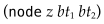 .
Let’s say we have
.
Let’s say we have  has height h_1 and l_1 leaves,
and that
has height h_1 and l_1 leaves,
and that  has height h_2 and l_2 leaves.
Since the addition of one in the definition of the height and the subtraction of one from the theorem statement cancel out, our goal is that 2^{max(h_1,h_2)} ≤ l_1 + l_2
Inversion tells us we have two subcases is at least 1,
 , and
, and
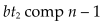 .
In this case, we can use our earlier theorem about perfect trees to
conclude that 2^{h_1} ≤ l_1 and induction to conclude that
2^{h_2-1} ≤ l_2. Furthermore, by the proof in the exercise above and
the one in the exercise below, we know that the height of
.
In this case, we can use our earlier theorem about perfect trees to
conclude that 2^{h_1} ≤ l_1 and induction to conclude that
2^{h_2-1} ≤ l_2. Furthermore, by the proof in the exercise above and
the one in the exercise below, we know that the height of  and
and  are both
  and thus equal to each other, so let’s
replace the h_2s in the goal with h_1,
and we can simplify the use of max. So, our
our goal specializes to
2^{h_1} ≤ l_1 + l_2
From the induction on
and thus equal to each other, so let’s
replace the h_2s in the goal with h_1,
and we can simplify the use of max. So, our
our goal specializes to
2^{h_1} ≤ l_1 + l_2
From the induction on  , and since adding l_2 onto
l_1 does not decrease it, we have finished this case.
, and since adding l_2 onto
l_1 does not decrease it, we have finished this case.In the other subcase, we know that
 is at
least 2,
is at
least 2,  , and
, and
 . As in the previous case,
by the results from the two exercises, we know that the
max expression in the goal specializes to h_2,
meaning our goal becomes 2^{h_2} ≤ l_1 + l_2 We can
also use the previous result about perfect trees to conclude
that 2^{h_2} = l_2, which gives us the overall result.
. As in the previous case,
by the results from the two exercises, we know that the
max expression in the goal specializes to h_2,
meaning our goal becomes 2^{h_2} ≤ l_1 + l_2 We can
also use the previous result about perfect trees to conclude
that 2^{h_2} = l_2, which gives us the overall result.
Exercise 2. Show that, if we know that  , then
the height of
, then
the height of  is
is  .
.
Exercise 3. Show that, with the specific given definitions
above, for any  , if
, if  , then
 .
.
Exercise 4. The converse of the claim in the previous exercise
is false. That is, it is not true that if  then
then  . Find one of the smallest possible binary trees that is
complete but not perfect and write out the derivation showing it is
complete.
. Find one of the smallest possible binary trees that is
complete but not perfect and write out the derivation showing it is
complete.
1.5 Contexts
A very powerful concept for defining relations is the idea of a context, which we’ll focus on for this section, returning to how the context is actually useful in later sections.
We write  , to decompose a binary
tree into two pieces, a context
, to decompose a binary
tree into two pieces, a context  , which is a
binary tree with a specific spot called the hole
somewhere inside it, plus another binary tree that is placed
at the hole in the context.
, which is a
binary tree with a specific spot called the hole
somewhere inside it, plus another binary tree that is placed
at the hole in the context.
Here is the definition of the set of contexts  ; they
use the same grammar-based definition technique as before,
but when we define them, we ensure that the definition is
formulated so that there is exactly one hole, written
; they
use the same grammar-based definition technique as before,
but when we define them, we ensure that the definition is
formulated so that there is exactly one hole, written
 , in each element of the set
  .
.
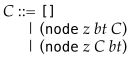
As an example, on the left we have an element of the set
 , and on the right we have an ordinary binary tree.

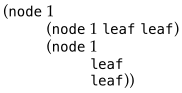
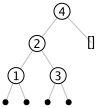
Contexts can also be drawn as trees, but we just write
 somewhere at the bottom. Here’s the same context
and tree:
somewhere at the bottom. Here’s the same context
and tree:

We can combine them by placing the tree in the hole:
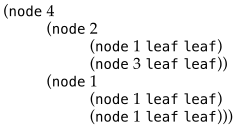
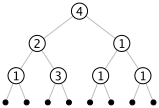
As contexts allow us to pick out subtrees of binary trees, they also allow us to pick out subtrees of perfect and complete binary trees. Let’s prove a lemma that says that such subtrees of perfect trees are themselves perfect.
Theorem. For any context  and binary tree
  , if
, if
 then
then  for
some
for
some  .
.
 .
.
If
 is
is  , then
  is
is  .
So we can choose
.
So we can choose  to be
to be  to satisfy the goal.
If
 is
is 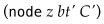 then we should
apply induction on the inner
then we should
apply induction on the inner  . To do so, we have
to show that
. To do so, we have
to show that  is perfect. For that, we
turn to our assumption that
is perfect. For that, we
turn to our assumption that  .
In this case, however, we know the outer layer of
.
In this case, however, we know the outer layer of  ,
which means that
,
which means that  is perfect.
Because of what it means to replace a term in the hole, this is the
same thing as
is perfect.
Because of what it means to replace a term in the hole, this is the
same thing as  and thus we
know that
and thus we
know that  . By
inversion on the definition of a perfect binary tree, we know that
both
. By
inversion on the definition of a perfect binary tree, we know that
both  and
and  are perfect binary trees
(with height
are perfect binary trees
(with height  ),
setting us up to use induction, which gives us the desired result.
),
setting us up to use induction, which gives us the desired result.The final case is that
 is
is  . This proceeds
in an analogous manner to the previous case.
. This proceeds
in an analogous manner to the previous case.
QED.
Exercise 5. The converse, namely that if
 then
then
 for some
  is
false. Give a counterexample.
is
false. Give a counterexample.
Exercise 6. Prove that for any context  and binary tree
  , if
, if
 then
then  for
some
for
some  .
.
1.6 Relations as Computation
Beyond using relations to capture particular desirable subsets of the sets we have defined, we can also use relations to capture a form of computation, where we relate one element of a set to another one.
The interpretation of these relations will be that some small amount of computation has occurred to transform one tree into the other one.
For our binary trees, we’ll use a relation that, step by
step, adds up the values in nodes, removing one node at a
time as it does so. The relation is written
 to indicate that we can add two
integers together in
to indicate that we can add two
integers together in  and update the tree by
removing one of the nodes to produce
and update the tree by
removing one of the nodes to produce  .
.
Contexts offer great expressiveness in defining these relations because we can factor out the specific computational step from the place where it occurs inside the tree. Here is the the definition of the relation to illustrate the idea.
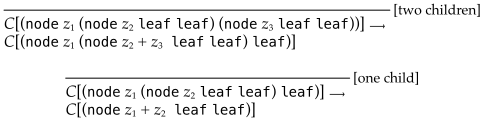
This relation has two rules. First, focus on the part inside the hole in the first rule. In the portion before the arrow, it has a node with two children that each have two leaves for children. In the portion after the arrow, we remove the right child, and update the left child’s value to be the sum of the two values in the original children. The second rule is similar, but this time the outer node has one node for a child and a leaf, and we sum the values into the node.
 , it means that the rules can apply in
any context in the set
, it means that the rules can apply in
any context in the set  . The simplest such context
is just
. The simplest such context
is just  , meaning that the relation relates these
two trees by the first rule:
, meaning that the relation relates these
two trees by the first rule:
But because the  in the rule can be an arbitrary
element of the set
in the rule can be an arbitrary
element of the set  , it might also have been the
example above, meaning that these two trees are also related
by the relation, as are many others.
, it might also have been the
example above, meaning that these two trees are also related
by the relation, as are many others.

1.7 A Preservation Proof
The two rules in the definition of the
 relation are enough to reduce every
binary tree that has any numbers to one that contains just a
single number. Additionally, it is even possible to reduce
every complete tree to another complete tree. Let’s try to
prove this.
relation are enough to reduce every
binary tree that has any numbers to one that contains just a
single number. Additionally, it is even possible to reduce
every complete tree to another complete tree. Let’s try to
prove this.
Although this proof differs in specific ways from the kinds of proofs we will be doing for type systems, it is illustrative of the general kind of thinking we need when doing those proofs.
 , if
, if  , then
either
, then
either
 is
is 
 is
is  for some
  , or
, or There is a
 such that
  for some
 and
and  .
.
As stated, this theorem is true, but not amenable to induction. Let’s see what goes wrong.
 .
.
 is
is  , which is one of the cases in the conclusion.
 is
is 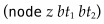 for some
 ,
,  , and
, and  .
Since
.
Since  , by inversion we know that
there are two subcases. Let’s focus on the first one
to see where the proof goes wrong. It says that
, by inversion we know that
there are two subcases. Let’s focus on the first one
to see where the proof goes wrong. It says that
 is at least 1,
 , and
, and
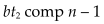 . Since we know that
 is complete, we can apply induction, which gives us
three possibilities. The first one is that
is complete, we can apply induction, which gives us
three possibilities. The first one is that
 is
is  and the second one is that
 is
is  , and these are not problematic.In the third situation that induction gives us, we know that there is a
 such that
 for some
  , and
, and
 . At this point, we might wish to say
that binary tree
. At this point, we might wish to say
that binary tree 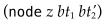 is complete to
finish this case. Unfortunately, all we know is that
is complete to
finish this case. Unfortunately, all we know is that
 and we need to know that
 . In particular, we do not know
that
. In particular, we do not know
that  is the same as
  . And, in fact, it
might not be! For example, the tree
. And, in fact, it
might not be! For example, the tree
 is complete with height 2, and it is related to
 by the [one child] rule, but that binary tree has height 1.
This does not make the theorem false, however. What has gone wrong is that our inductive hypothesis is not strong enough. That is, the information we learn from induction is weaker than what is actually true. This is one of the essential truths when working with proofs by induction: sometimes we have to prove state a stronger result to be able to get useful facts from induction. Indeed, this becomes a balancing act, as stating a strong result gives us more information from induction, but also means we have to establish harder-to-prove goals.
 ” aspect of the theorem statement.
This does not tell us anything about the
” aspect of the theorem statement.
This does not tell us anything about the  , which
is why we got stuck. But we know something about
, which
is why we got stuck. But we know something about  .
Let’s look at a few examples. There are two situations;
first there is a situation like this one, where we are
summing up elements along the bottom row but we have not yet
reached the leftmost spot on the bottom row:
.
Let’s look at a few examples. There are two situations;
first there is a situation like this one, where we are
summing up elements along the bottom row but we have not yet
reached the leftmost spot on the bottom row:
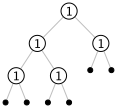
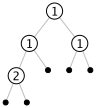
The next step after, however, demonstrates the other situation. It gives us a complete tree with a height that’s one smaller. And, when that happens, we will actually always get a tree that’s not just complete, but also perfect:

Let’s turn this observation into a more precise statement we can use a lemma to prove the original theorem.
 , if
, if  , then
either
, then
either
 is
is 
 is
is  for some
  ,
, there is a
 such that
  and
and
 , or
, orthere is a
 such that
  and
and
 , or
, or
Proof. By induction on  .
.
 is
is  , which is one of the cases in the conclusion.
 is
is 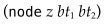 for some
 ,
,  , and
, and  .
Since
.
Since  , by inversion we know that
there are two subcases.
, by inversion we know that
there are two subcases.
- In the first subcase from inversion, we know that
 is at least 1,
 , and
, and
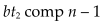 . Since we know that
 is complete, we can apply induction, which gives us
four possibilities.
is complete, we can apply induction, which gives us
four possibilities.
The first case is that
 is
is  . We can use
inversion on the fact that
. We can use
inversion on the fact that 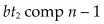 to
learn that
to
learn that  is zero, and thus
  must be 1.
Therefore, we know that
must be 1.
Therefore, we know that  which, from
inversion tells us that
which, from
inversion tells us that  must be
  .
Therefore, this case satisfies the second clause in the lemma
statement.
.
Therefore, this case satisfies the second clause in the lemma
statement.The second case from induction is that
 is
is  . This case is similar to the
previous case, except that the binary tree is larger; as
before, examining the definition of complete binary trees
gives us enough information to establish this case; it uses
the third case in the lemma statement.
. This case is similar to the
previous case, except that the binary tree is larger; as
before, examining the definition of complete binary trees
gives us enough information to establish this case; it uses
the third case in the lemma statement.In the third situation that induction gives us, we know that there is a
 such that
 and
and
 . The
. The  that
satisfies the lemma is
that
satisfies the lemma is
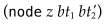 and it does so via the third
alternative in the lemma statement. To prove that, we have to show that
and it does so via the third
alternative in the lemma statement. To prove that, we have to show that
 and
and  . For the first,
we can use the [right] rule in the definition of complete binary trees.
For the second, consider the
. For the first,
we can use the [right] rule in the definition of complete binary trees.
For the second, consider the  that was used to conclude
 . We can extend it to
  and then
use that to conclude that
and then
use that to conclude that  .
.In the fourth situation that induction gives us, we know that there is a
 that is perfect with
height
that is perfect with
height  such that
 . The
. The  that satisfies the
lemma in this case is
that satisfies the
lemma in this case is 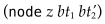 . We can
conclude that
. We can
conclude that  by extending the context
as we did in the previous case, but this time to
by extending the context
as we did in the previous case, but this time to
 .
.To show that
 is complete, let’s remind
ourselves what we know about the subtrees of
is complete, let’s remind
ourselves what we know about the subtrees of  .
From inversion at the start of this case, we know that
.
From inversion at the start of this case, we know that
 . We also learned, from induction,
that
. We also learned, from induction,
that  . We can use these facts
together with the [right] rule to conclude that
. We can use these facts
together with the [right] rule to conclude that
 , which satisfies the third clause of the
goal of the lemma.
, which satisfies the third clause of the
goal of the lemma.
- In the second subcase from inversion, we know that
 is at
least 2,
is at
least 2, 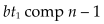 , and
, and
 . This time, we can do
induction on
. This time, we can do
induction on  , giving us four more subcases:
In the first subcase, we know that
 is
is  .
By inversion of
.
By inversion of 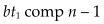 we know that
 must be zero. But this is impossible and thus
 could not actually have been
  in this situation.
Exercise 7. Around half of the the proof above is missing,
specifically the last three subcases of 2b (the second case of inversion in
the case that  is
is  ).
Complete the proof.
).
Complete the proof.