2 The let-zl language
2.1 Syntax
The let-zl language has expressions  defined as follows:
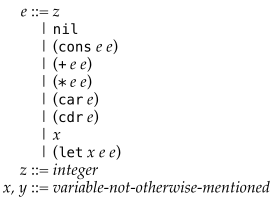
There are two kinds of literal expressions, integers  and the empty
list
and the empty
list  . Additionally, we build longer lists with
  ,
which is our traditional cons that creates a linked list node with first and
rest. We have two elimination forms for integers,
,
which is our traditional cons that creates a linked list node with first and
rest. We have two elimination forms for integers,
 and
and  .
Additionally, we have elimination forms for lists,
.
Additionally, we have elimination forms for lists,  and
and
 . Finally, we have variables
  , and we have a form of
sharing in
, and we have a form of
sharing in  , which binds
  to the value of
 in
in  .
.
2.2 Dynamic semantics
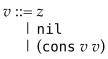
 , the empty list
 , and pairs of values
  .
.
 portion of each term
is the evaluation context, which means that addition can be performed
not just on whole terms, but within terms according to a grammar given
below.
portion of each term
is the evaluation context, which means that addition can be performed
not just on whole terms, but within terms according to a grammar given
below.
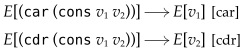
 then
then
 extracts the first value
  and
and  extracts the
second value
extracts the
second value  .
. involves substituting the value for
the variable in the body:
involves substituting the value for
the variable in the body:

 and evaluation contexts
  :
:

Evaluation context  give a grammar for where evaluation can take place.
For example, suppose we want to reduce the term
give a grammar for where evaluation can take place.
For example, suppose we want to reduce the term  .
We need to decompose that term into an evaluation context and a redex, so that
they match one of the reduction rules above. We can do that: the evaluation
context is
.
We need to decompose that term into an evaluation context and a redex, so that
they match one of the reduction rules above. We can do that: the evaluation
context is  , which matches the grammar of
  , and
the redex in the hole is thus
, and
the redex in the hole is thus  . This decomposition matches rule
[plus], which converts it to
. This decomposition matches rule
[plus], which converts it to  . Then to perform
another reduction, we decompose again, into evaluation context
. Then to perform
another reduction, we decompose again, into evaluation context  and redex
  . That converts to
  plugged back into the
evaluation context, for
plugged back into the
evaluation context, for  . Then to perform one more reduction step,
we decompose into the evaluation context
. Then to perform one more reduction step,
we decompose into the evaluation context  and the redex
 , which converts to
  .
.
We define  to be the reflexive, transitive closure of
  .
That is,
.
That is,  means that
  reduces to
  in
zero or more steps.
in
zero or more steps.
The dynamic semantics of let-zl is now given by the evaluation function eval, defined as:
eval(
) =
if


As we discuss below, eval is partial for let-zl because there are errors that cause reduction to get “stuck.”
Exercise 8. Extend the language with Booleans. Besides Boolean literals, what do you think are essential operations? Extend the dynamic semantics with the necessary reduction rule(s) and evaluation context(s).
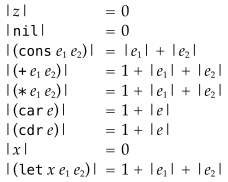
Exercise 9. Prove that for all values,  = 0.
= 0.
2.2.1 Errors
Can let-zl programs experience errors? What does it mean for a reduction
semantics to have an error? Right now, there are no explicit, checked errors,
but there are programs that don’t make sense. For example,  .
What do these non-sense terms do right now? They get stuck! That is,
a term that has
.
What do these non-sense terms do right now? They get stuck! That is,
a term that has  in the hole won’t reduce any further.
 and
and  .
. and
and  , where
  is an integer.
 or
or  where
where  or
or  is not an integer.
Any open term, that is, a term with a variable that is not bound by
 .
.
What do these stuck states mean? They might correspond to a real language executing an invalid instruction or some other kind of undefined behavior. This is no good, but there are several ways we could solve the problem.
 to
configurations
to
configurations  :
:

 , thus flagging them as errors.

We now update our evaluation function eval to take these errors into account:
eval(
) =
if
eval(
) =
if


Alas, eval is still partial, because there are stuck states that we haven’t converted to wrong states. (The other reason that eval could be partial is non-termination, but as we will prove, we don’t have that.) A second way to rule out stuck states is to impose a type system, which rules out programs with some kinds of errors. We can then prove that no programs admitted by the type system get stuck, which will make eval total for this language.
2.3 Static semantics

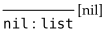
 to be lists of integers.
 :
:

 :
:
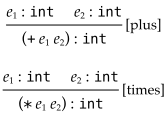
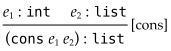
 , we require that the first operand be an integer
and the second be a list, and then the whole thing is a list:
, we require that the first operand be an integer
and the second be a list, and then the whole thing is a list:
 and
and  , we require that the operand be a list;
the result for
, we require that the operand be a list;
the result for  is an integer, and the result for
  is
another list:
is
another list:

 , we get stuck. What’s the type of
a variable? To type check variables, we introduce type environments, which keep
track of the type of each
, we get stuck. What’s the type of
a variable? To type check variables, we introduce type environments, which keep
track of the type of each  -bound variable:

 through. For
example, the rule for
through. For
example, the rule for  becomes
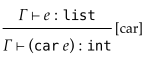
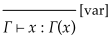
 . To type check a
variable, look it up in the environment:
. To type check a
variable, look it up in the environment:
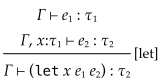
 , we first type check
 , yielding some type
  . We then type check
 with an environment extended with
  bound to
 . The resulting type,
  , is the type of the whole
expression:
, is the type of the whole
expression:
Exercise 10. Extend the type system to your language with Booleans.
Exercise 11 (Generic lists). Modify the type system as follows: instead of a single type
 for lists of
  s, allow
  ,
,
 ,
,  and so on.
How do you have to change the syntax of
and so on.
How do you have to change the syntax of  ? The typing rules?
2.3.1 Type safety
 has a type
  , then
one of:
, then
one of:
It will reduce in some number of steps to a value
 that also
has type
that also
has type  .
.It will reduce in some number of steps to
 .
.It will reduce forever.
Preservation: if
 has type
  and converts in
one step to
and converts in
one step to  , then
  also has type
  .
.Progress: if
 has a type
  , then either
  takes a conversion step or
  is a value.
2.3.1.1 Preservation
Before we start, we make an observation about how typing derivations must be formed.
 then,
then,
If the term is a variable
 then
then  =
=  .
.If the term is an integer
 then
then  =
=  .
.If the term is
 then
then  =
=  .
.If the term is
 or
or  then
then  =
=  and
and  and
and  .
.If the term is
 , then
  =
=  and
and  and
and 
If the term is
 then there is some type
 such that
  and
and
 .
.
Proof. By inspection of the typing rules.
We want to prove that if a term has a type and takes a step, the resulting
term also has a type. We can do this be considering the cases of the
reduction relation and showing that each preserves the type. Alas, each rule
involves evaluation contexts  in the way of the action. Consequently,
we’ll have to prove a lemma about evaluation contexts.
in the way of the action. Consequently,
we’ll have to prove a lemma about evaluation contexts.
Lemma (Replacement). If
 , then there exists some type
 such that
 . Furthermore, for any other term
  such that
  , it is the case that
 .
.
Proof. By induction on the structure of  :
:
If
 is
is  , then
  =
=  ,
so
,
so  must be
  . Then since
  ,
we have that
,
we have that  .
.If
 , then the only typing rule that applies
is [cons], which means that
, then the only typing rule that applies
is [cons], which means that  must be
  .
Furthermore, by inversion of that rule it must be the case that
.
Furthermore, by inversion of that rule it must be the case that
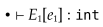 and
and  . By the induction
hypothesis on the former,
. By the induction
hypothesis on the former,  has some type
 , and furthermore, for any term
  that also
has type
that also
has type  , we have that
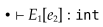 . Then by applying rule
[cons], we have that
. Then by applying rule
[cons], we have that
 .
.If
 , then as in the previous case, the only typing
rule that applies is [cons], which means that
, then as in the previous case, the only typing
rule that applies is [cons], which means that  must be
  . It also means that
 must have type
  and
and  must have type
  . Then by IH on the former,
 has a type
  , and furthermore, for any
  having type
  ,
,  .
Then by reapplying rule [cons], we have that
.
Then by reapplying rule [cons], we have that
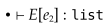 .
.If
 , then the only typing rule that applies is
[plus], which means that
, then the only typing rule that applies is
[plus], which means that  is
is  . It also
requires that
. It also
requires that  and
and
 both have type
  . Then apply IH to the former,
yielding that
. Then apply IH to the former,
yielding that  has some type
  . Furthermore, by
the IH, for any other
. Furthermore, by
the IH, for any other  having type
  , we have that
 . Then reapplying rule
[plus], we have that
. Then reapplying rule
[plus], we have that  .
.If
 or
or  or
or  ,
as in the previous case, m.m.
,
as in the previous case, m.m.If
 (or
(or  ) then the only typing rule
that applies is [car] (resp. [cdr]), which means
that
) then the only typing rule
that applies is [car] (resp. [cdr]), which means
that  is
is  (resp.
  ).
Furthermore, rule [car] (resp. [cdr])
requires that
).
Furthermore, rule [car] (resp. [cdr])
requires that  must have type
  .
Then apply IH to get that
.
Then apply IH to get that 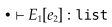 as well. Then
 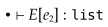 as well.
Then apply rule [car] (resp. [cdr]) to get that
as well.
Then apply rule [car] (resp. [cdr]) to get that
 has type
  (resp.
  ).
).If
 , then the only rule that applies is
[let]. By that rule,
, then the only rule that applies is
[let]. By that rule,  must have
some type
must have
some type  , and
, and 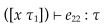 .
Then by the IH on the former,
.
Then by the IH on the former,  for some
 . Furthermore, for any other
  having type
 , the IH tells us that
 as
well. Then we can reapply rule [let] to get
as
well. Then we can reapply rule [let] to get
 .
.
QED.
There’s one more standard lemma we need before we can prove preservation:
Lemma (Substitution). If  and
and  then
then
 .
.
Proof. By induction on the typing derivation for  ; by cases
on the conclusion:
; by cases
on the conclusion:
 : Then
  is
is
 , and
, and  .
.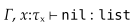 : Then
 is
is  , and
, and 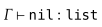 .
. : Then we know that
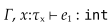 and
and
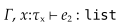 .
Then by the induction hypothesis,
.
Then by the induction hypothesis,
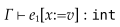 and
and
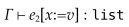 .
Then by rule [cons], we have that
.
Then by rule [cons], we have that
 .
But
.
But  is
is
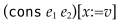 , so
, so
 .
. : Then we know that
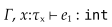 and
and
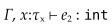 .
Then by the induction hypothesis,
.
Then by the induction hypothesis,
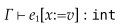 and
and
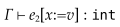 .
Then apply rule [plus].
.
Then apply rule [plus]. :
as in the previous case.
:
as in the previous case. : Then we know that
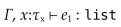 . Then by IH,
 .
And then by rule [car],
.
And then by rule [car],
 .
. :
As in the previous case.
:
As in the previous case. :
There are two possibilities, whether
:
There are two possibilities, whether  =
=  or not:
First, consider the case where
 ≠
≠  . Then we know that
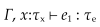 for some
  , and that
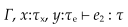 .
Then by the induction hypothesis,
.
Then by the induction hypothesis,
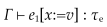 .
Because
.
Because  ≠
≠  ,
,  =
=  . (This reordering could be
proved correct in an “exchange” lemma, but we take it to be obviously
correct from the typing rules. Exchange will be of more interest when
linear type systems force us to get serious about contexts.)
So we have that
. (This reordering could be
proved correct in an “exchange” lemma, but we take it to be obviously
correct from the typing rules. Exchange will be of more interest when
linear type systems force us to get serious about contexts.)
So we have that
 .
Then by the induction hypothesis,
.
Then by the induction hypothesis,
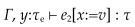 .
Then
.
Then  by rule
[let].
by rule
[let].If
 =
=  then, as before, the induction hypothesis
gives us that
then, as before, the induction hypothesis
gives us that 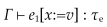 .
By the assumption we know that
.
By the assumption we know that
 . By inversion,
we know that
. By inversion,
we know that  .
But from the way environments work, we know that
.
But from the way environments work, we know that
 is the same
as
is the same
as  . Thus we know
 , which gives us
the pieces to use the let rule to conclude that
, which gives us
the pieces to use the let rule to conclude that
 , which
is almost what we need to finish this case.
Consider what the substituion function does when the variables
are equal:
, which
is almost what we need to finish this case.
Consider what the substituion function does when the variables
are equal:
 =
=
 =
=
 .
That means, that the typing derivation we just proved, namely
.
That means, that the typing derivation we just proved, namely
 is
the same as the one that finishes this case, and thus
is
the same as the one that finishes this case, and thus
 .
.
 :
There are two possibilities,
whether
:
There are two possibilities,
whether  =
=  or not:
If
 =
=  , then
  is
is  .
Furthermore, this means that
.
Furthermore, this means that  =
=  . And we
have from the premise that
. And we
have from the premise that  .
.If
 ≠
≠  , then
  is
is  .
Furthermore, we know that
.
Furthermore, we know that  =
=
 =
=  .
Then
.
Then  .
.
QED.
Now we are ready to prove preservation:
Lemma (Preservation). If  and
and
 then
then  .
.
Proof. By cases on the reduction relation:
 :
By the replacement lemma,
:
By the replacement lemma,  must have some type,
and by inversion, that type must be
must have some type,
and by inversion, that type must be  . The result of the
addition metafunction is also an integer with type
. The result of the
addition metafunction is also an integer with type  . Then
by replacement,
. Then
by replacement, 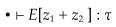 .
. :
as in the previous case.
:
as in the previous case. :
By the replacement lemma,
:
By the replacement lemma,  for some type
  . The only rule that applies is [car],
which requires that
. The only rule that applies is [car],
which requires that  =
=  and
and
 . This types only by rule
[cons], which requires that
. This types only by rule
[cons], which requires that  .
Then by replacement,
.
Then by replacement,  .
. :
By the replacement lemma,
:
By the replacement lemma,  for some type
  . The only rule that applies is [cdr],
which requires that
. The only rule that applies is [cdr],
which requires that  =
=  and
and
 . This types only by rule
[cons], which requires that
. This types only by rule
[cons], which requires that  .
Then by replacement,
.
Then by replacement,  .
. :
By the replacement lemma,
:
By the replacement lemma,  for some types
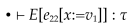
  . The only rule that applies is [let],
which requires that
. The only rule that applies is [let],
which requires that  for some
  such
that
such
that 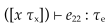 . Then by the substitution lemma,
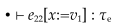 . Then by replacement,
 .
.
QED.
2.3.1.2 Progress
Before we can prove progress, we need to classify values by their types.
Lemma (Canonical forms).
 has type
  , then:
If
 is
is  then
then  is an integer literal
 .
.If
 is
is  , then either
  =
=  or
or  =
=  where
where
 has type
  and
and  has type
  .
.
Proof. By induction on the typing derivation of
 :
:
 : Then
  is an integer literal.
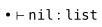 : Then
  is the empty list.
 : By the syntax of values
it must be the case that
: By the syntax of values
it must be the case that  is a value
  having type
 , and
, and  is a value
  having type
 .
.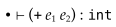 : Vacuous, because not a value.
The remaining cases are all vacuous because they do not allow for value forms.
QED.
Lemma (Context replacement). If  then
then
 . If
. If  then
then 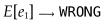 .
.
Proof. If  then
then  must be some redex
in a hole:
must be some redex
in a hole:  . Furthermore, it must take a step to some
 =
=  . Then the same redex
  converts to the same contractum
  in any evaluation context, including
 .
.
If  then
then  must be some redex in a hole:
 which converts to
  . Then that same redex
converts to
. Then that same redex
converts to  in any evaluation context, including
 .
.
Lemma (Progress). If  then
term
then
term  either converts or is a value.
Proof. By induction on the typing derivation; by cases on the conclusion:
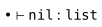
 : Then
  is a value.
 : Then
  is a value.
 :
Then
:
Then  and
and  .
By the induction hypothesis, term
.
By the induction hypothesis, term  either converts, or is a value.
If
either converts, or is a value.
If  converts to some term
  , then
 by the context replacement lemma.
If
by the context replacement lemma.
If  converts to
  , then
 by the context replacement lemma.
If
by the context replacement lemma.
If  is a value
  , then consider
  , which by
the induction hypothesis either converts or is a value.
If
, which by
the induction hypothesis either converts or is a value.
If  converts to a term
  , then
 by the context replacement lemma.
If
by the context replacement lemma.
If  converts to
  , then
 by the context replacement lemma.
Finally, if
by the context replacement lemma.
Finally, if  is a value
  then
then  is a value
  .
.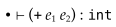 :
Then
:
Then  and
and  .
By the induction hypothesis,
.
By the induction hypothesis,  either converts or is a value.
If
either converts or is a value.
If  converts to a term
  , then
 by the context replacement lemma.
If
by the context replacement lemma.
If  converts to
  then
then
 by the context replacement lemma.
If
by the context replacement lemma.
If  is a value
  , then consider
  , which by
the induction hypothesis either converts or is a value.
If
, which by
the induction hypothesis either converts or is a value.
If  converts to a term
  , then
 by the context replacement lemma.
If
by the context replacement lemma.
If  converts to
  , then
 by the context replacement lemma.
Otherwise,
by the context replacement lemma.
Otherwise,  is a value
  . By the canonical forms lemma,
 is an integer
  and
and  is an integer
 . Thus, we can take the step
 .
. : As in the previous case.
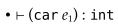 :
Then
:
Then  .
By the induction hypothesis,
.
By the induction hypothesis,  either converts or is a value.
If it converts to a term
either converts or is a value.
If it converts to a term  , then
 by the context replacement lemma.
If it converts to
by the context replacement lemma.
If it converts to  , then
 by the context replacement lemma.
Otherwise,
by the context replacement lemma.
Otherwise,  is a value. By the canonical forms lemma,
it has the form
is a value. By the canonical forms lemma,
it has the form  , so we can take a step
 .
.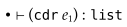 : As in the previous case,
but reducing to
: As in the previous case,
but reducing to  .
. : Vacuous.
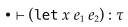 :
Then
:
Then  and
and 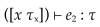 for some
  .
Then by the induction hypothesis,
.
Then by the induction hypothesis,  either converts or is a value.
If
either converts or is a value.
If  converts to a term
  , then
 by the context replacement lemma.
If
by the context replacement lemma.
If  converts to
  then
then
 by the context replacement lemma.
Otherwise,
by the context replacement lemma.
Otherwise,  is a value
  , and
, and
 .
.
QED.
Exercise 12. Prove progress and preservation for your language extended with Booleans.
Exercise 13. Prove progress and preservation for your language extended with generic lists.
Exercise 14. Are the previous two exercises orthogonal? How do they interact or avoid interaction?
2.4 Termination
Now let’s prove a rather strong property about a rather weak language.
Theorem (Size is work). Suppose  and
and
 = k. Then
  either reduces to a value or goes wrong in
k or fewer steps.
either reduces to a value or goes wrong in
k or fewer steps.
Proof. This proof uses induction, but it uses induction on
the set ℕ × ℕ, using a lexicographic ordering. That is, we
consider the first natural number to be the number of nodes
in the given  (when viewed as a tree) and the second
one to be
(when viewed as a tree) and the second
one to be  . The lexicographic order is well-founded,
and so we can use induction when we have a term where the
. The lexicographic order is well-founded,
and so we can use induction when we have a term where the
 is strictly less than the given one, or when
 is the same as the given one, but the number of
nodes is strictly smaller.
is the same as the given one, but the number of
nodes is strictly smaller.
 : Then k = 0, and
  reduces to value
  in 0 steps.
 : Also k = 0.
 . Then by inversion of [cons],
 and
and  .
Let j be the size of
.
Let j be the size of  ; then the size of
  is
k – j. We can use induction on both
is
k – j. We can use induction on both  and
and  ,
because they both have strictly fewer nodes that
,
because they both have strictly fewer nodes that  ,
and
,
and  and
and  are both less than or
equal to
are both less than or
equal to 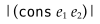 . (With the exception of the
 case, the justification for induction will be the same
as this one in all the other cases.)
Then by induction,
case, the justification for induction will be the same
as this one in all the other cases.)
Then by induction,  reduces to a value
 or to
or to  in j or fewer steps.
If it reduces to
in j or fewer steps.
If it reduces to  then
by the context replacement lemma,
then
by the context replacement lemma,  also reduces
to
also reduces
to  in j or fewer steps.
Otherwise, consider the induction hypothesis on
in j or fewer steps.
Otherwise, consider the induction hypothesis on
 (size k – j);
it must reduce to a value
(size k – j);
it must reduce to a value  or to
or to  in k – j or
fewer steps.
If
in k – j or
fewer steps.
If  , then the whole thing goes wrong by context replacement.
Otherwise,
, then the whole thing goes wrong by context replacement.
Otherwise,  goes to
  in
k or fewer steps.
in
k or fewer steps. . Then by inversion of the typing rule
  , both
subterms have type
, both
subterms have type  . Let j be the size of
  ; then
the size of
; then
the size of  is k – j – 1.
Then by the induction hypothesis, each
reduces to a value or goes wrong, in at most j and k – j – 1 steps
respectively. If either goes wrong, then the whole
term goes wrong because both
is k – j – 1.
Then by the induction hypothesis, each
reduces to a value or goes wrong, in at most j and k – j – 1 steps
respectively. If either goes wrong, then the whole
term goes wrong because both  and
and  are evaluation contexts. Otherwise, by the canonical values lemma both
values must be numbers
are evaluation contexts. Otherwise, by the canonical values lemma both
values must be numbers  and
and  . Because
 in j or fewer steps, by context replacement
 in j or fewer steps.
And because
in j or fewer steps.
And because
 in k – j – 1 or fewer steps,
by context replacement again
in k – j – 1 or fewer steps,
by context replacement again
 in k – j – 1 or fewer steps.
Then in one more step
in k – j – 1 or fewer steps.
Then in one more step
 , which is a value.
The total number of steps has been k or fewer.
, which is a value.
The total number of steps has been k or fewer. : As in the previous case, m.m.
 and
and  : In either case, the subterm
 must have type
  by inversion of the typing rule.
Furthermore, the size of
by inversion of the typing rule.
Furthermore, the size of  must be k – 1.
Then by the induction hypothesis,
must be k – 1.
Then by the induction hypothesis,  either reduces to a value
or goes wrong in k – 1 or fewer steps.
If it goes wrong then the whole term goes wrong.
If it reduces to a value, then by preservation, that value also has
type
either reduces to a value
or goes wrong in k – 1 or fewer steps.
If it goes wrong then the whole term goes wrong.
If it reduces to a value, then by preservation, that value also has
type  . (Note also that it also reduces to a value in the
evaluation context
. (Note also that it also reduces to a value in the
evaluation context  .)
Then by the canonical values lemma, that value
must be either
.)
Then by the canonical values lemma, that value
must be either  or
or  for some values
 and
and  . If the former then the whole term goes to
 in one more step by rule [car-nil] or rule
[cdr-nil],
respectively. If the latter, then it take one more step to
in one more step by rule [car-nil] or rule
[cdr-nil],
respectively. If the latter, then it take one more step to
 or
or  , respectively. In either case, k steps have
transpired.
, respectively. In either case, k steps have
transpired. : Vacuous because open terms don’t type.
 : By inversion, we know that
 for some type
  . And we know that
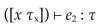 .
Let j be the size of
.
Let j be the size of  ; then the size of
  is
k – j – 1. We can use induction on
is
k – j – 1. We can use induction on  because
  is
less than
is
less than 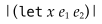 and there are strictly
few nodes. Thus, by induction on
and there are strictly
few nodes. Thus, by induction on  ,
we have that
,
we have that  reduces to a value or goes wrong in j or fewer
steps. If it goes wrong then the whole term goes wrong. If it reduces to
a value
reduces to a value or goes wrong in j or fewer
steps. If it goes wrong then the whole term goes wrong. If it reduces to
a value  , then by context replacement (and induction on the
length of the reduction sequence), the whole term reduces
, then by context replacement (and induction on the
length of the reduction sequence), the whole term reduces
 in j or fewer steps.
Then in one more step,
in j or fewer steps.
Then in one more step,
 .
Note that because the size of a variable is 0 and so is the size of
a value, the size of
.
Note that because the size of a variable is 0 and so is the size of
a value, the size of  is the same as
the size of
is the same as
the size of  , k – j – 1, which is strictly less than
the size of
, k – j – 1, which is strictly less than
the size of  . In this case,
the number of nodes in
. In this case,
the number of nodes in  might be many
more than the number of nodes in
might be many
more than the number of nodes in  because
  might
be a long list. But we set up our induction using the lexicgraphic
order so that we only need to consider the relative sizes of
might
be a long list. But we set up our induction using the lexicgraphic
order so that we only need to consider the relative sizes of
 and
and  , not
the number of nodes them to justify induction. Now, by preservation,
, not
the number of nodes them to justify induction. Now, by preservation,
 . So we an apply the
induction hypothesis to
. So we an apply the
induction hypothesis to  , learning that
it goes wrong or reaches a value in k – j – 1 or fewer steps.
This yields a total of k or fewer steps.
, learning that
it goes wrong or reaches a value in k – j – 1 or fewer steps.
This yields a total of k or fewer steps.
QED.